Tuesday, September 30, 2008

iHaveThatBook.com a new textbook exchange

Channel 6 News
Reported by: Erica Fox
It's a text book case of local students becoming entreprenuers. A couple of college room-mates say they got fed up with buying expensive textbooks and selling them back to the bookstore for next to nothing. So, they decided to start an online company to help students connect and save money.

"Debt. That was the first thing that I thought. 'Oh my gosh, I'm going to have so much debt leaving college,'" says Cal State San Marcos freshman Amanda Thompson.

She says she got the shock of her life buying textbooks this year for the first time.

"I spent close to $900 on books," Thompson says. "My parents reaction, they're just like, 'This is insanity.'"

That madness turned to opportunity for law student Adam Phillips and college senior Jared Herling.

"We felt like we were really getting ripped off," Phillips explains. "So, we decided to try and do something about it."

They started a website which aims to eliminate college bookstores that buy back used books for a fraction of the cost.

"They buy back $200 books for twenty to forty dollars and then, in turn, resell those books to other students at a price of about $100," explains Herling. "So what we're doing is we're cutting out that middle man."

The website allows any student in the country to buy and sell used books from each other.

"They could sell it for a dollar they could sell it for a hundred dollars," says Phillips.

"The site also compares the prices of online book retailers so students know the going rate. Since the new site launched at the beginning of this school year, Phillips and Herling say it's going amazingly well.

"We actually have, I believe, about 2000 users this month," Phillips explains.

He estimates in just a month the site has saved students about $20,000. Phillips and Herling hope they're just getting started.

"We're really hoping to completely change the way students connect," says Phillips.

Starting September 17th, students will be able to pay completely online using Paypal. It's a start up company so they're relying on word of mouth to advertise. They're putting up fliers and passing out t-shirts on campuses across San Diego.

Original Article and Video

Custom Textbooks

By JOHN HECHINGER
July 10, 2008; Page D1

College students, already struggling with soaring tuition bills and expenses, are encountering yet another financial hit: Publishers and schools are working together to produce "custom" textbooks that can limit students' use of the money-saving trade in used books. And in a controversial twist, some academic departments are sharing in the profits from these texts.

TAILOR-MADE FOR SCHOOL
Publishers are pushing "custom" textbooks designed to be unique for each school.
The special texts make it harder for students to buy and sell in the used-book market, so they often end up spending more for course materials.
Schools often receive a royalty payment on each book sold.

The University of Alabama, for instance, requires freshman composition students at its main campus to buy a $59.35 writing textbook titled "A Writer's Reference," by Diana Hacker.

The spiral-bound book is nearly identical to the same "A Writer's Reference" that goes for $30 in the used-book market and costs about $54 new. The only difference in the Alabama version: a 32-page section describing the school's writing program -- which is available for free on the university's Web site. This version also has the University of Alabama's name printed across the top of the front cover, and a notice on the back that reads: "This book may not be bought or sold used."

Custom textbooks like this one are proliferating on U.S. college campuses, guaranteeing hefty sales for publishers -- and payments to colleges that are generally undisclosed to students. The publisher of the Alabama book -- Bedford/St. Martin's, based in Boston -- pays the Tuscaloosa school's English department a $3 royalty on each of the 4,000 copies sold each year. And though the prohibition on selling the book used can't be legally enforced, the college bookstore won't buy the books back, making it more difficult for students to find used copies.

[photo]
Sergio Capursi/WSJ
The cover of the University of Alabama custom version of 'A Writer's Reference' is nearly identical to the standard version.

Textbook companies and college officials involved in such deals say custom textbooks provide needed resources for academic departments and more-useful materials for students.

But Ann Marie Wagoner, a 19-year-old University of Alabama freshman who pays $1,200 a year for textbooks, calls the cost of new custom books "ridiculous" and complains that students aren't told about the royalties. "They're hiding it so there isn't a huge uproar," she says.

The custom-textbook business has become the fastest-growing segment of the $3.5 billion market for U.S. new college texts, comprising 12% of sales for 2006, the latest year for which data is available. Royalty deals generate tens of thousands of dollars for some big academic departments. The arrangements have drawn little attention, despite increasing legislative and regulatory scrutiny of the spiraling price of textbooks, which have been rising at twice the rate of inflation over the past two decades.

In 2005, a report by the U.S. Government Accountability Office criticized several textbook industry practices -- including frequent new editions and the "bundling" of books with extras like CDs and workbooks -- that discourage the purchase of used books and inflate prices for students.

The agency found that college students spend an average of about $900 a year on textbooks. That's the equivalent of 8% of tuition and fees at the average private four-year college, 26% at a state university and 72% at a community college.

Controlling Textbook Costs

In recent years, 34 states have proposed or passed legislation to control textbook costs, including measures to prohibit inducements to professors for adopting textbooks, according to a May 2007 congressional study. A bill pending in Congress would require more disclosure of textbook pricing, in part by requiring publishers to sell textbooks separately from the bundles of extras with which they are now often packaged.

The book-royalty arrangements resemble a practice exposed during last year's student-loan scandal, when some universities steered students to particular lending firms and received a secret cut of the loans. New York Attorney General Andrew Cuomo called those payments "kickbacks" and forced universities, many of which said they used the money to fund scholarships, to halt the practice. Mr. Cuomo recently launched a broad conflict-of-interest investigation of the relationship between colleges and vendors, including book publishers.

For publishers, the custom market is a way to thwart used-book sales, which cut deeply into their profits. Though used books have been around for decades, they have become a much bigger industry threat in the Internet age. Web sites for used books, such as Amazon.com1 and eBay, have transformed fragmented, campus-by-campus dealings in old texts into a national market, where discounts of 50% off the new-book price are common. Because of their limited audience, custom books are difficult to resell -- and they sometimes aren't eligible for authorized campus book-buyback programs.

James V. Koch, former president of Old Dominion University and the University of Montana, says that colleges, rather than requiring students to buy custom texts, should post exclusive material free on university Web sites. Prof. Koch, an economist who studied textbook costs for a Congressional advisory committee last year, says royalty arrangements involving specially made books may violate colleges' conflict-of-interest rules because they appear to benefit universities more than students.

'Unethical Behavior'

"It treads right on the edge of what I would call unethical behavior," he says. "I'm not sure it passes the smell test." Many colleges forbid professors from personally accepting royalties when they assign their own books for classes; others have no rules.

At the University of Alabama, Carolyn Handa, who until recently directed the school's writing program, acknowledges that students can save money if they buy used standard editions or sell their books at the end of the term. But Prof. Handa says the university edition is designed as a long-term reference. "You don't sell back your dictionary after your first year of college," she says. "It should be a resource they have on their shelf."

The writing program so far has collected about $20,000 in royalties in the two years since it started requiring custom textbooks, Prof. Handa says. She adds that she regularly declines pitches from other publishers offering even higher royalties. "I feel bad enough getting $3," she says.

Prof. Handa says the royalty money helps pay for trips to conferences for graduate students and will underwrite teaching awards. This year, three graduate students received about $500 apiece to attend the April convention of the Conference on College Composition and Communication in New Orleans.

Bedford/St. Martin's is a unit of Macmillan, which is owned by German publishing giant Verlagsgruppe Georg von Holtzbrinck GmbH. Brian Napack, president of Macmillan, says university departments deserve royalties because of the time they spend putting together custom texts. "We didn't come to the market to give departments royalties," he says. "We think there's a decent argument to be made for it. It's a nice bonus for colleges to have a couple of extra bucks to use for education."

Attracted to 15% annual sales growth, big players such as Pearson PLC, McGraw-Hill Cos. and Macmillan are all making major pushes into the custom-book field. In part, that's because technology has made it cost-effective for customers to create specialized books for relatively few students. Proponents say students often complain that professors use only a few chapters of standard texts, whereas custom books can follow a course precisely.

Searching Facebook

Nicole Allen, textbooks advocate for U.S. Public Interest Research Groups -- a consumer organization -- says students, faced with buying a custom textbook, should ask the professor whether they can instead make do with a used standard version. If a custom text is required, students can try to find it used through local book exchanges or by searching social-networking sites such as Facebook for students who have recently taken the course and may want to sell a copy, Ms. Allen says.

Some custom books involve more than just little tweaks of established texts. At Virginia Tech, about 3,000 first-year students annually buy a required composition guide created by its faculty. The school distributes a new edition each year featuring student work. At the university bookstore, the text, published by Pearson, sells for about $50. Carolyn Rude, who chairs the English department, says the book helps provide consistency across more than 100 sections of freshman composition by ensuring a standard curriculum. She wouldn't disclose the precise amount of the royalty but said it was "several dollars" per book and generated about $20,000 annually. The university uses the money to bring in expert speakers and pay for $600 research and travel stipends for instructors, Prof. Rude says.

A $10 Royalty per Book

Pennsylvania State University recently ended a contract with Pearson for the roughly 10,000 students taking introductory economics courses. The economics department received a $10 royalty for each custom textbook students purchased, generating about $50,000 a year for the program, says Susan Welch, dean of the college of liberal arts. But, Prof. Welch says, the school was uncomfortable "making money on students like that," and the arrangement discouraged students from buying cheaper, used books. Under a new contract with Pearson, Penn State now uses standard texts with no royalties, as well as custom course packs.

Don Kilburn, chief executive of Pearson's custom-publishing division, says royalties are justified when professors and others "put in a fair amount of time and effort." Pearson says it pays royalties on 300 of roughly 9,000 custom projects. Mr. Kilburn acknowledged that custom books have lower resale value for students. But with custom books, he says, students "get something better suited for their needs."

The Textbook System

Who knew the college textbook marketplace could be so complex? The agents in this ecosystem and their interests are so intertwined that as a whole it poses a massive amount of inertia for those who attempt to change the marketplace. I’ve been involved for about a year with an effort to change the textbook ecosystem for Ohio college students, and I am amazed at the complexity with each new layer of the onion that is peeled back. I thought it worthwhile to document my findings here and ask what insights others have.

The Big Picture

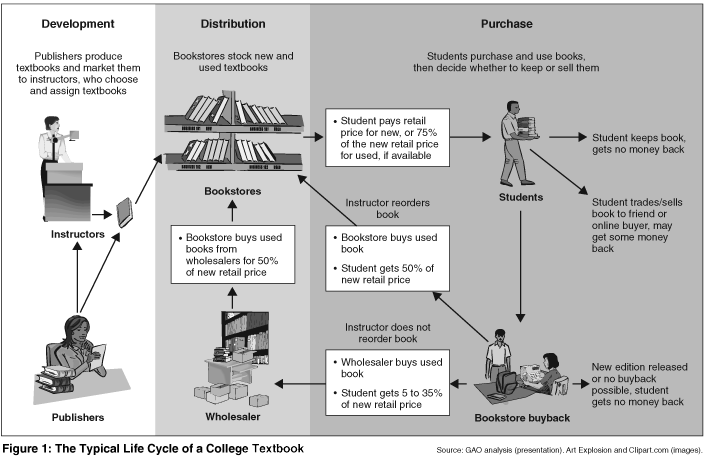
In July 2005, the United States Government Accountability Office published a report called College Textbooks: Enhanced Offerings Appear to Drive Recent Price IncreasesL1 that documents in great detail the complexity of the textbook ecosystem.

Figure 1 from page 5 of the report graphically depicts the life cycle of the college textbook along with the players in its ecosystem: publishers, instructors, bookstores, students, and used textbook wholesalers. The short version is this: Publishers create a textbook. Instructors tell Bookstores the textbooks they want to use for a course. Bookstores estimate the number of copies needed and buy stock from Used Textbook Wholesalers and Publishers. Students purchase the textbook from the Bookstore, and sometimes sell the textbook back to the Bookstore at the end of the term.

The Effect of Used Textbooks

There are, of course, many variables in this ecosystem. Used textbooks are highly sought by both the Bookstores and the Students. For Students, the used textbook is sold at a lower cost than the new version — typically about 75% of the new textbook cost. For Bookstores, the sale of a used textbook is a higher margin sale — averaging 33% versus the 23% margin for new textbook sales. 1 There are also actions that Bookstores can take to improve their margin. If the Bookstore knows that the Instructor will use the book again, it will buy back and warehouse more of that particular book from students at the end of the term. More used books held over by the Bookstore from term to term means the Bookstore does not need to buy and pay for the shipping of as many textbooks to meet student needs for the following term. The Bookstore may even offer higher prices to students who sell back these desired books. On the other hand, the Bookstore will offer lower prices for books that are not desired as much. A Bookstore may even refuse to buy back a current edition of a textbook when it knows a new edition is coming from the Publisher for the next term and the Instructor has requested the new edition.

So Bookstores try hard to get next term’s textbook selections from Instructors before the current term ends. With that information the bookstore manager can make better guesses and assume less risk in buying back books that the Bookstore won’t use. In the end, the Used Textbook Wholesaler is an agent that the Bookstore can use to attempt to smooth out the ripples between used textbooks on-hand and the demands for the new term. And as a last resort, since the margins are lower, it will stock new textbooks from the publisher. Between the actions of the Bookstore and the Used Textbook Wholesaler along with cooperation from Instructors, the used textbook market has become a very efficient part of the textbook ecosystem.

Publishers, on the other hand, probably don’t like this increased efficiency in the used textbook market. A publisher makes no money on a used textbook sale, so it typically had two options: 1) raise the new textbook price to spread the fixed capital costs of creating a new textbook among fewer purchases; and/or 2) employ strategies to force Students to purchase more new textbooks. The former is a matter of simple economics; Publishers spend upwards of $1 million dollars to create the book and the accompanying materials2 and those costs must be made up somehow. The latter occurs by publishing new editions more frequently and/or through “bundlingL3” (forcing students to buy the textbook by combining it with one-time-use consumables like workbooks or term-limited website passwords). [Update 20080710T0954 : Publishers have another way of restricting the used textbook market: custom publishing. This is discussed in an article in the Wall Street JournalL4.]

The Digital Option

There is a third option now: use digital delivery to eliminate the Bookstore, its markup and its used textbook market. By dealing directly with Students, the Publisher could remove the influence of the Bookstore and the Used Textbook Wholesaler from the ecosystem; as a consequence it can lower the price and increase its own margin. The Publishers also gain an advantage by removing the used textbook market; the Student’s username/password to the digital editions hosted on the publisher’s website expire after a set period of time (typically six months to a year). Expired username/passwords are worthless, so the secondary used market dries up. (There is typically also contract language that the user accepts during the purchase process that says the student will not share or resell access to the publisher’s content.) No secondary market means that Publishers are assured of more sales to Students over the Bookstore-mediated market; as a consequence, the Publisher can spread their fixed capital costs over more unit sales, thereby lowering the per-unit cost.

Each of the major publishers has their own e-commerce site for digital textbook delivery, but the Publishers thought this was such a good idea (or at least thought it was a good idea to eliminate confusion on where to go to get an e-textbook) that they came togetherL5 and formed a companyL6 called CourseSmartL7 as a one-stop shop for students purchasing textbooks.3 The Bookstores, understandably, are not pleased with the creation of CourseSmartL8 and its trade organization, NACS, is reviewing the arrangement through the lens of U.S. antitrust lawsL9. The Bookstore is not out of the equation entirely, though.

The Bookstore’s Response

Call it a variation on the Publisher’s new digital delivery option: wholesaler-supplied e-textbooks. One of the largest Used Textbook Wholesalers, MBSL10, has their own multi-publisher e-textbook platform called Universal Digital TextbooksL11. It is not an e-commerce site — one must purchase the access codes for the e-textbooks through a Bookstore — but once one has access it is functionally equivalent to the CourseSmart site. It also happens that MBS and one of the largest college bookstore service providers, Barnes and Noble College StoresL12, share a common fiscal beneficiaryL13, Leonard RiggioL14. This combined Bookstore/Used-Textbook-Wholesaler operation4 has a deep interest in not being removed from the textbook ecosystem. The other major college bookstore management company, FollettL15, is following a similar path by recently purchasing another e-textbook operationL16 called CafeScribeL17. (And if you think the matrix of players isn’t complicated enough, know that Publisher-owned CourseSmart has now partneredL18 with Nebraska Book CompanyL19, yet another college bookstore management company and Used Textbook Wholesaler, as a bookstore distribution channel for CourseSmart content.)

The Bookstore is also more than just a retailer of textbooks (electronic or not). It is also a service center for the purchase of textbooks. For instance, many bookstores will do the collection of required textbooks for Students and have the package ready for students to walk in and pay for. Bookstores are also agents for those receiving various scholarships (e.g. athleticL20 and others) that include a textbook benefit provision. The Bookstore’s accounting mechanism ensures that designated scholarship funds are spent only on textbooks. There is not a national database of such scholarship recipients that a site like CourseSmart could use to provide an equivalent service — it is typically strictly a local endeavor. I’ve also heard in one anecdotal statement that Bookstores carry the debt of the sale of the textbooks to some scholarship recipients until the end of the term in accordance with the policies of the scholarship-granting agency. That may not be a service that a low-margin, online retail business model can offer. Perhaps this is the reason that Publishers seem to be unwilling to cut the Bookstores and the Used Book Wholesalers out of the digital market completely. After all, the Publishers have a choice as to whom they will give the digital version of their content; the Publishers could choose not to give the digital version to the MBS and Follett for their delivery systems. The reasons why Publishers would seemingly sacrifice margin to these alternate digital delivery systems is one of my unresolved questions.

And the Students? An Untested Analogy…

Students are reacting to increases in textbook prices in a way that is strikingly similar to that of the music recording industry versus listeners. The unit prices of the product have gone up (CDs / textbooks) while the introduction of ways to sell used items (CD exchange stores / textbook buybacks) result in a drop of first-copy sales. Digital delivery enters the landscape (via record company websites, iTunes and Amazon / publisher websites and bookstore/wholesaler websites), and the price drops a bit. (As we run our pilots, part of the equation is to seek a significant discount for digital delivery over the price of a new physical textbook.) Digital Rights Management is in the equation on both sides, with (in my opinion) only modest success. There are even reports of students engaging in digital piracyL21 via Bittorrent with publishers clamoring to get the content removedL22 and perpetrators standing behind a statement of “civil disobedience” against “the monopolistic business practices” of textbook publishersL23.

I did notice a great resource for students and faculty. A site called iHaveThatBook.com lets students compare digital sources like coursesmart, amazon, and half.com. It also lets students buy and sell textbooks from other students. Not to mention they let professors have access to a free course management and allow students to exchange notes as well. Maybe the students will solve the problem themselves!

Looking for a Path out of this Mess

I think it would be safe to say that no one is terribly happy with the status quo — if there is such a thing as a steady-state with all of the pieces of the ecosystem changing so quickly. In addition to efforts in the OhioL25 legislatureL26 to get a handle on this, the federal reauthorization of the Higher Education ActL27 contains provisions related to the disclosure of data in the textbook ecosystemL28. It would certainly have an impact on quality and quantity of information about the various flows of data in the ecosystem. The result will be a shifting of players and price in the marketplace, but I’m not convinced this leads to a more fundamentally ecosystem.

Among the many unanswered questions in this ongoing exploration is why technology has not dramatically reduced the costs of the materials themselves. In other industries (computer hardware and software, music, automobiles, etc.) the introduction of technology has lead to falling prices (as compared to inflation) and rising functionality. This doesn’t seem to be the case in textbooks, where price increases are surpassing inflationL29 and the product is not getting dramatically better. It is enough to make one wonder if there is something special about the textbook ecosystem or if this is the result of inequitable market forces.

Extending the analogy between the textbook ecosystem and the music ecosystem, you may wonder if there is the equivalent to the Creative Commons activity of the latter. 5 In fact, there is; such content is commonly called Open TextbooksL30 or OpenCourseWareL31. The PIRG “Make Textbooks Affordable” campaign describes itL32 this way: “Open textbooks are free, online, open-access textbooks. The content of open textbooks is licensed to allow anyone to use, download, customize, or print without expressed permission from the author.” Others, such as Flat World KnowledgeL33, seek new business models like giving away the content online and charging for derivatives such as audio formats, print, and study aids. [Update 20080710T0953 : An article from USA Today talks more about Flat World Knowledge and the concept of open textbooksL34.]

Your Thoughts

So this is how I’ve come to know the textbook ecosystem as a librarian peering into unfamiliar places and relationships. Is this how you see the marketplace as well? Whether your a Student, Instructor, or a representative from a Publisher, Bookstore or Used Textbook Wholesaler, I’m interested in your thoughts. Please send them to me privately (contact informationL35) or publicly in the comment section of this entryL36.

Updates

Thursday, July 10th: Nicole Allen, Textbooks Program Director at The Student PIRG, sent me an email where she lists two articles related to textbooks that were published in major newspapers today. First is As Textbooks Go ‘Custom,’ Students Pay4 from page D1 of today’s Wall Street Journal. It describes another way that publishers deal with the used textbook market: custom publishing.

The University of Alabama, for instance, requires freshman composition students at its main campus to buy a $59.35 writing textbook titled “A Writer’s Reference,” by Diana Hacker. The spiral-bound book is nearly identical to the same “A Writer’s Reference” that goes for $30 in the used-book market and costs about $54 new. The only difference in the Alabama version: a 32-page section describing the school’s writing program — which is available for free on the university’s Web site. This version also has the University of Alabama’s name printed across the top of the front cover, and a notice on the back that reads: “This book may not be bought or sold used.”

The second is from USA Today entitled “Online ‘textbooks’ see college doors opening34” and goes more in depth on the open textbook movement and the business model of Flat World Knowledge.

Friday, July 11th: Even while this post was being conceived, news was spreading about an agreement between the Colorado Community College System and Pearson Education for flat pricing of digital textbook material. I found this via a convoluted path starting from a link that Lorcan Dempsey posted in a comment on this blog entry and ended up with a summary of the program posted on DLTJL37.

High Textbook Costs

New York Times
Editorial
Published: April 25, 2008

College students and their families are rightly outraged about the bankrupting costs of textbooks that have nearly tripled since the 1980s, mainly because of marginally useful CD-ROMs and other supplements. A bill pending in Congress would require publishers to sell “unbundled” versions of the books — minus the pricey add-ons. Even more important, it would require publishers to reveal book prices in marketing material so that professors could choose less-expensive titles.

The bill is a good first step. But colleges and universities will need to embrace new methods of textbook development and distribution if they want to rein in runaway costs. That means using digital textbooks, which can often be presented online free of charge or in hard copies for as little as one-fifth the cost of traditional books. The digital books can also be easily customized and updated.

Right now, textbook publishers are calling the tune. They add as many bells and whistles as they can and pump out new editions as quickly as possible — as a way of making perfectly good textbooks obsolete. Not every book can be cheap. A specialized text that only a few people know how to write and that reaches a small audience will be costly by definition. But there is no reason for an introductory textbook to carry a price tag of, say, $140 in an area like economics where the information changes little from year to year.

Schools are beginning to balk at outrageous pricing. Rice University offers textbooks for some classes free online and charges a nominal fee for the printed version. A new company called Flat World Knowledge, based in Nyack, N.Y., plans to offer online textbooks free and hopes to make its profit by selling supplemental materials like study guides and hard copies printed on demand.

A study being carried out by the geographer Ronald Dorn at Arizona State University suggests that students who use free online textbooks perform as well academically as students who buy expensive copies from traditional publishers. Colleges and universities should take advantage of these new developments.

Cash-strapped students and their families need all the relief they can get.